Imaging, Tracer Conjugation
Heterobifunctional PEG
- *
By Functional Group 1
By Functional Group 2
PEG Length
Application
Filtered by
Clear All
| Catalog No. | Name | Structure | M.W. | Purity | Buy |
|---|---|---|---|---|---|
|
BPG-1769
CAS: 86770-67-4
|
Azido-PEG4-alcohol |

|
219.24 | ≥ 96 % | |
|
BPG-1712
CAS: 134978-97-5
|
2-(2-(2-Aminoethoxy)ethoxy)acetic acid |

|
163.17 | ≥95% | |
|
BPG-1728
CAS: 208827-90-1
|
Triethylene Glycol Mono(2-propynyl) Ether |

|
188.22 | >95% | |
|
BPG-1778
CAS: 5650-20-4
|
Tetraethylene glycol monoethyl ether |

|
222.28 | 95 % | |
|
BPG-2441
CAS: 1427004-19-0
|
DBCO-PEG4-NHS ester |

|
649.69 | >95% | |
|
BPG-2317
CAS: 1702356-19-1
|
BCN-PEG4-NHS ester |

|
538.59 | ≥98% | |
|
BPG-3585
CAS: 1263044-56-9
|
MC-PEG2-C2-NHS ester |

|
467.47 | ≥98% | |
| BPG-4552 | Methyltetrazine-PEG4-STP Ester |

|
686.6 | N/A | |
| BPG-4549 | Methyltetrazine-PEG2-NH-Boc |

|
375.4 | N/A | |
| BPG-4548 | Methyltetrazine-PEG24-amine |

|
1244.5 | 0.98 | |
|
BPG-4547
CAS: 2143958-58-9
|
Methyltetrazine-amido-PEG8-amine, TFA salt |

|
624.7 | 0.95 | |
|
BPG-4546
CAS: 2141976-28-3
|
Methyltetrazine-PEG3-amine |

|
404.5 | N/A | |
| BPG-4545 | Methyltetrazine-PEG6-amine HCl salt |

|
488 | 0.98 | |
| BPG-4544 | Methyltetrazine-amido-PEG8-alkyne |

|
619.7 | 0.98 | |
| BPG-4543 | Methyltetrazine-PEG8-alkyne |

|
534.6 | 0.95 | |
|
BPG-4542
CAS: 2754372-80-8
|
Methyltetrazine-PEG24-acid |

|
1317.5 | 0.97 | |
| BPG-4541 | Pyrene-PEG4-Methyltetrazine |

|
605.7 | N/A | |
| BPG-4540 | N-Methylaniline-PEG3-methyltetrazine |

|
579.7 | 0.95 | |
| BPG-4539 | Methyltetrazine-PEG4-Dihydrofuran |

|
529.6 | 0.95 | |
| BPG-4538 | Diazo-PEG3-methyltetrazine |

|
854 | 0.98 |
Background
Heterobifunctional PEG is a multifunctional polymer. Unlike homobifunctional PEG, which has the same functional groups at both ends, heterobifunctional PEG has different functional groups at both ends. This unique structure allows the molecule to better accommodate different biomolecules, thus facilitating its selectivity and functionality for drug delivery of a wide range of bioconjugates. BOC Sciences offers bifunctional groups such as biotin, MAL, carboxyl, CLS, DBCO, amino, etc., which can be used in different combinations to provide a wide range of multifunctional products to our customers. These groups can be combined in various combinations to provide customers with a wide range of multifunctional products.
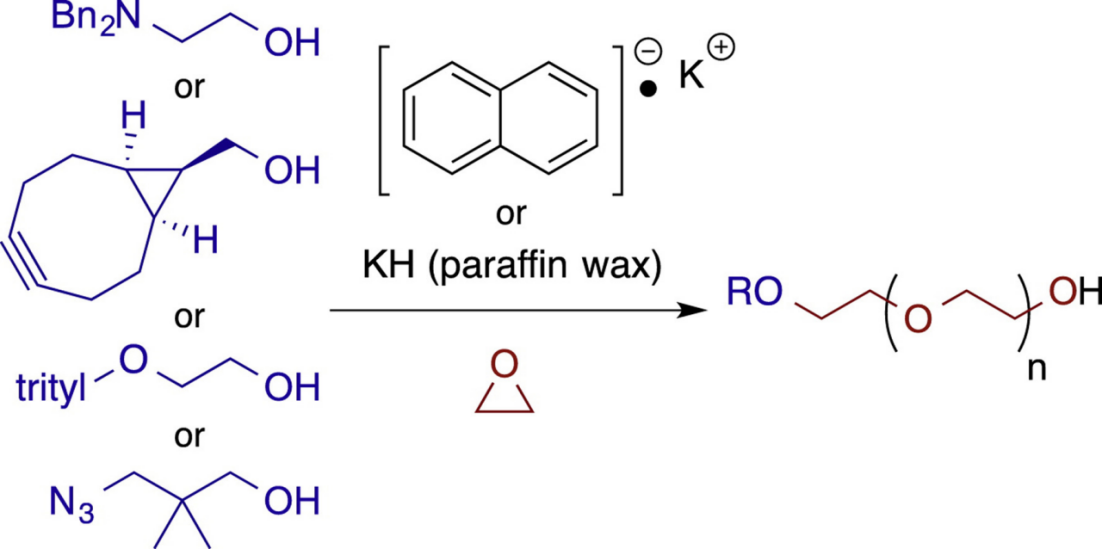 Fig. 1. Synthesis of heterobifunctional polyethylene glycols (Polymer, 2016, 105: 72-78).
Examples of Heterobifunctional PEGs
Due to the ability to link different groups at the ends of the PEG, heterobifunctional PEGs have many variants with specific functional groups at the ends, including those mentioned above. The following are some common examples of heterodifunctional PEGs.
MAL-PEG-COOH
MAL-PEG-COOH has a maleimide and a carboxyl group at each end of the molecular chain, making it a useful cross-linking reagent for PEG spacers. MAL-PEG-COOH can be used to modify proteins, peptides, or other surfaces containing sulfhydryl groups.
NH2-PEG-COOH
NH2-PEG-COOH has an amino group and a carboxyl group at each end of the molecular chain and is a useful reagent for crosslinking with PEG spacers. It can be used to affix a protein or peptide to a solid support or another biomolecule.
MAL-PEG-AC
MAL-PEG-AC is a linear heterofunctional PEG reagent having maleimide and acrylate at the ends of the molecular chain. It can be used in cell culture, drug research, drug delivery and release, nanotechnology and new materials. It can also be attached to different molecules or materials to extend the richness of different molecular combinations.
In addition to the common examples mentioned above, our product list also supplies a variety of heterobifunctional PEG with different functional groups, all of which have different functions and properties.
Structural Properties of Heterobifunctional PEG
The structural properties of heterobifunctional PEG are based on PEG and functional groups. Among them, the length of the PEG chain can be customized to achieve specific properties such as solubility, flexibility, and spatial resistance. And since the choice of functional groups at the ends of heterobifunctional PEG affects their reactivity, stability and compatibility with the target molecule. Therefore, careful selection of functional groups is essential to ensure efficient and specific splicing reactions while minimizing non-specific interactions.
How to Prepare Heterobifunctional PEG?
Heterobifunctional PEG can be prepared by two main methods.
(1) Modification of PEG derivatives
Starting with a PEG derivative that already possesses one of the functional groups, other functional groups are then introduced through chemical modification, such as esterification, amidation, or nucleophilic substitution reactions. Purification techniques are used to obtain pure heterobifunctional PEG.
(2) Modification of homobifunctional PEG
Heterobifunctional PEG can be prepared by selectively modifying one end of the homobifunctional PEG. The functional groups at one end are substituted to obtain the target product through a variety of techniques.
Advantages of Heterobifunctional PEG
- Flexibility - The ability to selectively introduce different functional groups at each end of the PEG chain provides great flexibility in the design of bioconjugates and drug delivery systems.
- Optimized Product Functionality - PEGylation of biomolecules or drug delivery systems can extend their circulation time, reduce their immunogenicity and improve their pharmacokinetic profile.
- Ease of Access - The well-established synthesis and commercial availability of heterobifunctional PEGs make them readily available to researchers.
With its expertise in PEG functionalization development, BOC Sciences plays a vital role in providing high-quality heterobifunctional PEG to support cutting-edge research and development in the biotechnology and pharmaceutical industries. If you are interested in our PEG modification and functionalization, please get in touch with us.
Reference
- Vojkovsky, T. et al. Synthesis of heterobifunctional polyethylene glycols: polymerization from functional initiators. Polymer. 2016, 105: 72-78.
Planning to purchase or looking for custom solutions?
Get in touch with our experts today! We'll respond within 24 hours to discuss your project needs and provide a customized quote.
You May Also Be Interested In
From custom PEG synthesis to PEGylation support, explore tailored services designed to meet the specific needs of your research.
Gain Deeper Insights
Browse related content to gain a deeper understanding of PEG synthesis and manufacturing.
PEG and PEG Derivatives
-

-

Crosslinking, Surface Coating
-

Drug Delivery, Biomaterials
-

Surface Coating, Functionalization
-

Lipid Delivery, Membrane Targeting
-

Small-molecule Polyethylene Glycol
Solvents, Drug Formulation
-

tert-Butyl protected carboxylate PEG
Protected Synthesis, Conjugation
-

Coupling Reactions, Conjugation
-

Targeting, Affinity Labeling
-

Stealth, Drug Solubilization
Online Inquiry