Targeting, Cancer Therapy
NHS ester PEG
- *
By Functional Group 1
By Functional Group 2
PEG Length
Application
Filtered by
Clear All
| Catalog No. | Name | Structure | M.W. | Purity | Buy |
|---|---|---|---|---|---|
|
BPG-4807
CAS: 2801772-87-0
|
Azido-PEG9-NHS ester |

|
608.64 | N/A | |
|
BPG-4806
CAS: 2801772-85-8
|
Azido-PEG7-NHS ester |

|
520.54 | N/A | |
|
BPG-4418
CAS: 2765338-86-9
|
Fmoc-aminooxy-PEG12-NHS ester |

|
953.1 | 0.98 | |
| BPG-4417 | Bis-PEG18-NHS ester |

|
1105.2 | 0.98 | |
| BPG-4415 | N-(Benzyloxy carbonyl-PEG3)-N-bis(PEG4-NHS ester) |
-n-bis(peg4-nhs-ester).gif)
|
1030.1 | 0.95 | |
| BPG-4414 | N-(NHS ester-PEG6)-N-bis(PEG6-N-Boc) |
-n-bis(peg6-n-boc).gif)
|
1265.5 | 0.95 | |
|
BPG-4413
CAS: 2639395-38-1
|
DBCO-N-bis(PEG4-NHS ester) |
.gif)
|
995.03 | 0.95 | |
| BPG-4412 | N-(Mal-PEG8-carbonyl)-N-bis(PEG8-NHS ester) |
-n-bis(peg8-nhs-ester).gif)
|
1634.8 | 0.95 | |
| BPG-4411 | N-(Mal-PEG4-carbonyl)-N-bis(PEG4-NHS ester) |
-n-bis(peg4-nhs-ester).gif)
|
1106.2 | 0.98 | |
| BPG-4410 | N-(NHS ester-PEG3)-N-bis(PEG3-Mal) |
-n-bis(peg3-mal).gif)
|
999 | N/A | |
|
BPG-4408
CAS: 1858242-47-3
|
2,5-Dioxopyrrolidin-1-yl 2-(prop-2-yn-1-yloxy)acetate |
acetate.gif)
|
211.2 | N/A | |
|
BPG-4407
CAS: 2353409-78-4
|
Mal-NO2-Ph-PEG12-NHS |

|
959 | N/A | |
| BPG-4402 | N-(NHS ester-PEG4)-N-bis(PEG4-azide) |
-n-bis(peg4-azide).gif)
|
881 | 0.95 | |
| BPG-4401 | N-(DBCO-PEG4-carbonyl)-N-bis(PEG4-NHS ester) |
-n-bis(peg4-nhs-ester).gif)
|
1242.4 | 0.95 | |
| BPG-4400 | N-(NHS ester-PEG8)-N-bis(PEG8-azide) |
-n-bis(peg8-azide).gif)
|
1381.6 | 0.95 | |
| BPG-4399 | N-(NHS ester-PEG2)-N-bis(PEG3-azide) |
-n-bis(peg3-azide).gif)
|
704.7 | 0.95 | |
| BPG-4398 | N-(acid-PEG3)-N-bis(PEG4-NHS ester) |
-n-bis(peg4-nhs-ester).gif)
|
940 | 0.95 | |
|
BPG-4397
CAS: 899452-51-8
|
Bis-sulfone NHS Ester |

|
597.7 | 0.95 | |
| BPG-4396 | Mono-Sulfone NHS Ester |

|
429.5 | N/A | |
|
BPG-4395
CAS: 2655501-79-2
|
SPDP-Gly-Pro-NHS ester |

|
466.5 | 0.95 |
Background
NHS ester PEG is a compound with a PEG chain and an NHS ester functional group. The N-hydroxysuccinimide (NHS) ester-activated PEG ligand is an amine-responsive reagent that can be used for modifying proteins, peptides, or any other surfaces that have an available amino group. The NHS ester reacts efficiently with primary amino groups in neutral or weakly alkaline buffers to form stable amide bond. In addition to the N-terminus of each peptide, antibodies and other proteins typically contain multiple lysine (K) residues. NHS-activated PEG reagents can therefore be used to target multiple primary amines.
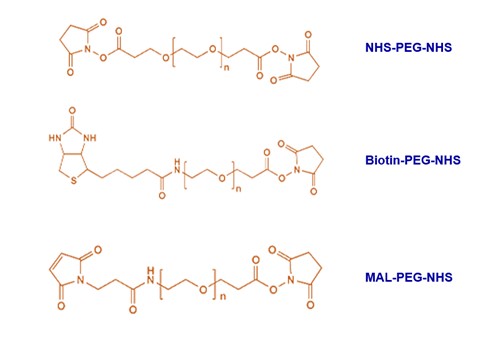 Fig. 1. Examples of NHS ester PEG.
Structural Features of NHS ester PEG
- PEG chain: The PEG chain is characterized by high solubility, hydrophilicity, low toxicity, high biocompatibility and structural tunability.
- NHS ester functional group: NHS ester (N-hydroxysuccinimide ester) is formed by the reaction of succinic acid and hydroxybutyrate. The NHS ester functional group is often used in biochemistry to react with amino compounds to form amino ester bonds.
- Hydroxybutyrate chain: The terminal hydroxybutyrate chain of NHS ester PEG is the part that reacts with the target compound. It can form amino ester bonds with biomolecules containing amino groups.
Examples of NHS ester PEG
Biotin-PEG-NHS
Biotin-PEG-NHS has biotin and NHS esters at each end of the molecular chain and can be used to label proteins, antibodies, small molecules or surfaces with available amine groups. At pH 7-9, the NHS ester reacts rapidly with primary amine groups to form stable amide bonds.
DSPE-PEG-NHS
DSPE-PEG-NHS can provide NHS groups for affixation to amine-containing portions or ligands. Its target molecules include antibodies, aptamers, proteins, and peptides, and are commonly used to deliver targeted drugs through lipid bilayers, extend circulating half-life, and reduce non-specific protein binding or cell adhesion.
MAL-PEG-NHS
MAL-PEG-NHS is a heterogeneous bifunctional modifier. It is mostly used in targeted drug research and has a wide range of applications in cross-linking of protein carriers and ligands.
NHS-PEG-Plys
NHS-PEG-Plys is a biodegradable polymer organic compound. Plys is rich in cations and has good membrane properties. Based on this property, Plys can be used as carriers for certain drugs and are therefore widely used in medical and pharmaceutical applications. NHS-PEG-Plys can be easily doped into liposomes and other nanoparticles via the NHS-amine reaction.
Functions of NHS Ester PEG
Biomarkers
NHS ester PEG can be used as a biomarker reagent for attaching PEG molecules to biomolecules. This PEG labeling can alter the properties of the biomolecule, such as increasing its solubility, stability, and cyclic half-life.
Surface Modification
NHS ester PEG can be used to surface modify materials. By attaching PEG molecules to the surface of a material, non-specific interactions between the material and the organism can be reduced, thus enhancing its performance in biomedical applications.
Resistance to Protein Adsorption
PEG has good hydrophilicity and can form a hydrated layer that prevents proteins from coming into direct contact with the surface of the material, thereby reducing the potential for non-specific adsorption and biodegradation.
Advantages of NHS ester PEG
- High Reactivity - The NHS ester functional group reacts very rapidly under alkaline conditions with compounds containing amino groups (NH2) to form stable amino ester bonds.
- Enhanced Stability - For biomolecules, PEG labeling can increase their cycle time and stability, prolonging their in vivo action.
- Convenient Chemical Modification - NHS ester PEG can be introduced into target compounds by reacting with compounds containing amino groups. This chemical modification method is simple and convenient and can be performed under laboratory conditions, providing flexibility and maneuverability for a variety of applications.
BOC Sciences offers high-quality PEG products with low polydispersity, high reactivity, and high purity. BOC Sciences' PEG products include PEG derivatives by structure, PEG derivatives by functional group, PEG raw materials, PEG copolymers, and more. If you are interested in our products, please feel free to contact us.
Planning to purchase or looking for custom solutions?
Get in touch with our experts today! We'll respond within 24 hours to discuss your project needs and provide a customized quote.
You May Also Be Interested In
From custom PEG synthesis to PEGylation support, explore tailored services designed to meet the specific needs of your research.
Gain Deeper Insights
Browse related content to gain a deeper understanding of PEG synthesis and manufacturing.
PEG and PEG Derivatives
-

-

PEGylated Hyaluronic Acid (HA)
Targeting, Tissue Engineering
-

Gene Delivery, Nanomedicine
-

Click Chemistry, Hydrogels
-

Small-molecule Polyethylene Glycol
Solvents, Drug Formulation
-

Amine Coupling, Conjugation
-

Drug Delivery, Material Design
-

Copper-Free Click Chemistry
-

Controlled Release, Nanoparticles
-

Crosslinking, Surface Coating
Online Inquiry