Crosslinking, Surface Coating
Maleimide(-MAL) PEG
- *
By Functional Group 1
By Functional Group 2
PEG Length
Application
Filtered by
Clear All
| Catalog No. | Name | Structure | M.W. | Purity | Buy |
|---|---|---|---|---|---|
| BPG-4879 | Mal(Br2)-AEEA |
-aeea.gif)
|
401.00 | >98% | |
|
BPG-4814
CAS: 2739896-54-7
|
Mal-propionylamido-PEG1-NHS-acetate |

|
367.31 | N/A | |
|
BPG-4812
CAS: 1373284-24-2
|
Mal-propionylamido-PEG2-NHS acetate |

|
411.37 | N/A | |
|
BPG-4811
CAS: 151225-46-6
|
Mal-propionylamido-PEG5-acetic acid |

|
446.45 | N/A | |
|
BPG-4810
CAS: 1424363-49-4
|
Mal-propionylamido-PEG4-acetic acid |

|
402.40 | N/A | |
|
BPG-4809
CAS: 450368-58-8
|
Mal-propionylamido-PEG3-acetic acid |

|
358.34 | N/A | |
|
BPG-4808
CAS: 936616-30-7
|
Mal-propionylamido-PEG2-acetic acid |

|
314.29 | N/A | |
|
BPG-4804
CAS: 1127247-28-2
|
MAL-PEG4-t-boc-hydrazide |

|
530.57 | N/A | |
|
BPG-4801
CAS: 518044-39-8
|
Mal-PEG6-CH2COOH |

|
419.42 | N/A | |
| BPG-4380 | Mal-PEG8-Amine, TFA salt |

|
492.6 | ≥98% | |
|
BPG-4379
CAS: 2170654-73-4
|
Mal-PEG5-amine TFA salt |

|
360.4 | 0.98 | |
|
BPG-4378
CAS: 2221042-92-6
|
Mal-PEG4-amine TFA salt |

|
316.4 | 0.98 | |
|
BPG-4377
CAS: 2101722-60-3
|
Mal-amido-PEG12-NHS |

|
865.9 | 0.95 | |
| BPG-4376 | 3,4-Dibromo-Mal-amido-PEG4-azide |

|
557.2 | 0.95 | |
| BPG-4375 | N-(t-butyl ester-PEG3)-N-bis(PEG3-Mal) |
-n-bis(peg3-mal).gif)
|
958.1 | N/A | |
| BPG-4374 | N-(Mal-PEG8-carbonyl)-N-bis(PEG8-t-butyl ester) |
-n-bis(peg8-t-butyl-ester).gif)
|
1552.9 | 0.98 | |
| BPG-4373 | Tri(Mal-PEG2-amide)-amine |
-amine.gif)
|
1077.2 | 0.98 | |
| BPG-4372 | Diphenylthiol-Mal-PEG8-PEG4-Biotin |

|
1182.5 | N/A | |
| BPG-4371 | Biotin-PEG4-Amide-PEG8-3,4-Dibromo-Mal |

|
1124 | 0.98 | |
| BPG-4370 | Methyltetrazine-PEG4-Amido-PEG8-Mal-3,4-Dibromo |

|
1024.8 | 0.98 |
Background
What is Maleimide PEG?
Maleimide (-MAL) PEG is a polyethylene glycol (PEG) molecule containing a maleimide functional group. The maleimide functional group in maleimide PEG allows specific conjugation reactions with molecules containing thiol (sulfhydryl) groups, such as cysteine residues in proteins or thiol-modified nucleotides. This conjugation reaction forms a stable covalent bond, making maleimide PEG useful for attaching PEG chains to proteins, peptides, or other molecules for various purposes, such as enhancing solubility, stability, or bioavailability.
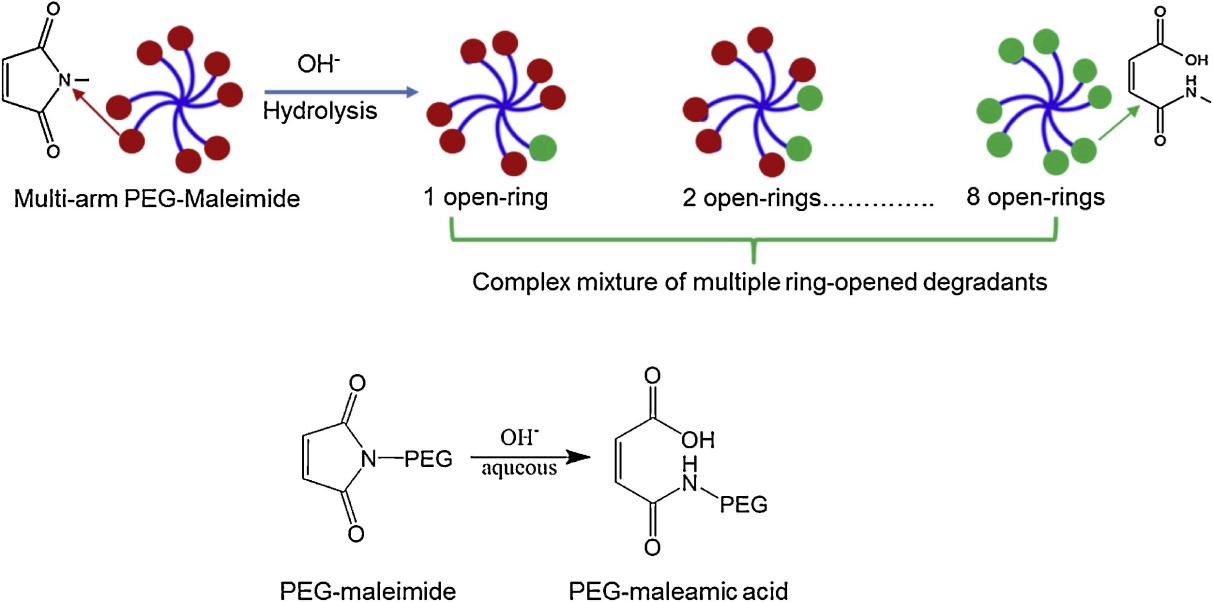 Fig. 1. Multiplicity of maleimide functional groups on the PEG chain (Journal of Pharmaceutical and Biomedical Analysis. 2019, 164: 452-459).
Functions of Maleimide PEG
Maleimide PEG has a variety of functions that allow it to be used in a variety of applications. The maleimide group can react with the thiol group to form a stable covalent bond, allowing maleimide PEG to be used for bioconjugation, drug delivery and tissue engineering. The hydrophilic and biocompatible nature of the PEG component allows maleimide PEG to be used as a coating material for pharmaceutical formulations and medical devices. The unique structure and chemistry of maleimide PEG makes it a versatile polymer that can be customized for specific applications.
Applications for Maleimide PEG
Maleimide PEG has a variety of applications in the biomedical field.
- Protein and Antibody Labeling - Maleimide-PEG is used for site-specific labeling of proteins and antibodies by concatenating the PEG portion with exposed cysteine residues.
- Drug Delivery Systems - Maleimide-PEG can be used to modify drug molecules or nanocarriers to enhance their solubility, stability and targeted delivery.
- Bioconjugation Strategies - Maleimide-PEG allows covalent attachment of therapeutic agents, imaging probes or other functional molecules to thiol-containing biomolecules such as peptides and proteins.
- Surface Modification - Maleimide-PEG can be used to modify the surface of materials such as nanoparticles and biosensors to enhance stability and biocompatibility.
- Diagnostic Assays - Maleimide-PEG can be used in a variety of diagnostic assays, including immunoassays and biosensors, to enable efficient attachment of biomolecules to sensor surfaces.
Benefits of Maleimide PEG
Maleimide-PEG offers several advantages that contribute to its widespread use in bioconjugation and other applications. These advantages include:
- High specificity. The maleimide moiety readily reacts with thiol-containing molecules, resulting in site-specific bioconjugation and minimal off-target modifications.
- Stable covalent bonding. The maleimide-thiol reaction forms a stable covalent bond, ensuring long-term stability of the bioconjugate.
- Controlled splicing. The selective reactivity of maleimide-PEG allows for precise control of the degree of splicing, providing the flexibility to modify the properties of the biomolecule.
- Enhanced water solubility. The PEG backbone improves the water solubility of maleimide-PEG, allowing for efficient concatenation in an aqueous environment.
- Reduced immunogenicity. The polyethylene glycolization of maleimide-PEG has been shown to reduce immunogenicity, making it suitable for biomedical applications.
BOC Sciences is a leading supplier of high-quality chemicals, including maleimide PEG, which is widely used in a variety of research applications. We offer a wide range of maleimide PEGs with varying molecular weights and functionalities to meet our customers' specific needs. Our maleimide PEG is of high quality and purity and we guarantee the best prices in the market. We also offer custom synthesis of maleimide PEG and other chemicals to meet the specific needs of our customers.
Reference
- Wang, J. et al. Multi-arm PEG-maleimide conjugation intermediate characterization and hydrolysis study by a selective HPLC method. Journal of Pharmaceutical and Biomedical Analysis. 2019, 164: 452-459.
Planning to purchase or looking for custom solutions?
Get in touch with our experts today! We'll respond within 24 hours to discuss your project needs and provide a customized quote.
You May Also Be Interested In
From custom PEG synthesis to PEGylation support, explore tailored services designed to meet the specific needs of your research.
Gain Deeper Insights
Browse related content to gain a deeper understanding of PEG synthesis and manufacturing.
PEG and PEG Derivatives
-

-

Drug Conjugates, Delivery
-

Acrylate/Acrylamide/Methacrylate PEG
Hydrogels, Polymerization
-

Imaging, Tracer Conjugation
-

Cell Targeting, Integrin Binding
-

Halide (chloride, bromide) PEG
Reactive Intermediates, Synthesis
-

Click Chemistry, Labeling
-

Controlled Synthesis, Protection
-

Gene Delivery, Cationic Carriers
-

Targeting, Cancer Therapy
Online Inquiry