Click Chemistry, Hydrogels
Aldehyde (Ald/CHO)PEG
- *
By Functional Group 1
By Functional Group 2
PEG Length
Application
Filtered by
Clear All
| Catalog No. | Name | Structure | M.W. | Purity | Buy |
|---|---|---|---|---|---|
|
BPG-4820
CAS: 1415246-46-6
|
Phthalamidoxy-PEG1-CH2-ald |

|
249.22 | N/A | |
|
BPG-4819
CAS: 1415246-44-4
|
Phthalamidoxy-PEG2-CH2-ald |

|
293.27 | N/A | |
|
BPG-4816
CAS: 1854065-96-5
|
Ald-benzyl-PEG4-propargyl |

|
292.33 | N/A | |
|
BPG-4815
CAS: 143570-97-2
|
4-(2-(2-(2-Hydroxyethoxy)ethoxy)ethoxy)benzaldehyde |

|
254.28 | N/A | |
|
BPG-4796
CAS: 2249926-66-5
|
Ald-CH2-PEG3-propargyl |

|
186.20 | N/A | |
|
BPG-4795
CAS: 1229024-41-2
|
Ald-CH2-PEG2-NHBoc |

|
247.29 | N/A | |
|
BPG-4792
CAS: 1491136-22-1
|
CHO-PEG2-COOtBu |

|
232.27 | N/A | |
|
BPG-3917
CAS: 2055105-36-5
|
Ald-Ph-PEG24-TFP ester |

|
1426.6 | 0.95 | |
|
BPG-3915
CAS: 674369-02-9
|
Ald-Ph-PEG24-NHS ester |

|
1375.6 | 0.98 | |
| BPG-3914 | Ald-Ph-PEG8-NHS ester |

|
670.7 | 0.95 | |
| BPG-3913 | Ald-Ph-PEG24-acid |

|
1278.5 | 0.98 | |
| BPG-3912 | Ald-Ph-PEG8-acid |

|
573.6 | 0.95 | |
| BPG-3911 | Fmoc-N-amido-PEG11-CH2-aldehyde |

|
765.9 | 0.98 | |
| BPG-3910 | Azido-PEG8-(CH2)3-aldehyde |
3-aldehyde.gif)
|
465.5 | 0.95 | |
| BPG-3909 | Ald-Ph-PEG8-t-butyl ester |

|
629.8 | 0.95 | |
| BPG-3908 | Diethyl acetal-PEG-OH, MW 1K-10K |

|
N/A | N/A | |
| BPG-0424 | Aldehyde-PEG-Aldehyde, MW 600-20k |

|
Customizable | N/A | |
| BPG-0026 | mPEG-ALD, MW 550-40k |

|
Customizable | N/A |
Background
Aldehyde (Ald/CHO)PEG is a compound that is a combination of polyethylene glycol (PEG) and an aldehyde group. Polyethylene glycol is a polymer with repeating glycol units, while aldehyde is a structural group containing a carbon-oxygen double bond and a hydrogen atom.
What is Aldehyde PEG?
Aldeyde PEG is an amine-reactive PEG derivative that can be used to modify biomolecules through available amine groups. The reaction between the aldehyde group and the ε-amine of the lysine residue and the N-terminal α-amine produces the intermediate Schiff base. Further reduction with hydride will form stable C-N bonds. PEG aldehydes react with amine groups at pH values from 5.5 to 9.5. Higher pH values will result in multiple polyethylene glycolization of the terminal groups and lysine groups. Aldehyde PEG is a commonly used PEG reagent for N-terminal polyethylene glycolization of proteins or peptides.
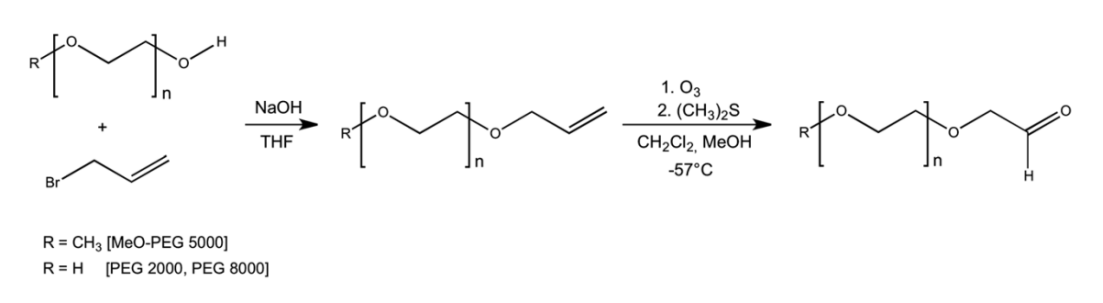 Fig. 1. Synthesis of PEG modified aldehyde (Polymers for Advanced Technologies. 2015, 26(12): 1456-1460).
Examples of Aldehyde PEG
Aldehyde-PEG-Maleimide
Aldehyde-PEG-Maleimide is one of the reagents for thiol (-SH) and N-terminal amine-based polyethylene glycolization. The maleimide group reacts rapidly and specifically with the thihydrogen (thiol) group at pH 6.5-7.5, while the aldehyde group reacts with the N-terminal α-amine to yield the intermediate. Polyethylene glycolated maleimides and aldehydes are water soluble and all reactions can be carried out in aqueous buffers.
Aldehyde-PEG-NHS
In the structure of Aldehyde-PEG-NHS, NHS stands for N-hydroxysuccinimide. NHS is a commonly used activating reagent that reacts with amine groups to form stable amide bonds. CHO-PEG-NHS is widely used in biochemistry and biomedicine to prepare bioconjugates with specific functionalities.
Aldehyde-PEG-Thiol
Aldehyde-PEG-Thiol is a linker for bioconjugation containing an aldehyde group and a terminal thiol group linked by a linear PEG chain. Conjugates can be prepared for biomarkers and bioimaging.
PEG Aldehyde Synthesis
The following is a procedure for the preparation of PEG Aldehyde:
Selection of PEG
Selection of the desired molecular weight and length of the PEG depends on the requirements of the final application. Common PEGmolecular weights range from 200 to 20,000 Da.
Selection of Appropriate Aldolization Reagents
Aldolization reagents include acetylaluminum oxide (Ac2O/Al2O3), acetic anhydride (Ac2O) and N-bromosuccinimide (NBS).
Aldehyde Reaction
PEG is reacted with an aldolization reagent in a suitable solvent. Typically, the reaction is carried out under an inert atmosphere (e.g., nitrogen) to prevent oxidation of the aldehyde group. The reaction temperature and reaction time depend on the selected reagent and reaction conditions.
Purification and Removal of By-products
The product after synthesis may contain unreacted reagents and by-products. Common purification methods include solvent extraction, gel permeation chromatography, and gel electrophoresis. Removal of by-products can be accomplished by appropriate washing steps.
Applications of Aldehyde PEG
Crosslinking Agent
Aldehyde-PEG can be used as a cross-linking agent for biomaterials and hydrogels. Aldehyde-PEG can undergo a condensation reaction with compounds containing amino functional groups to form a stable cross-linked network. This crosslinked network can be used to prepare highly biocompatible materials, microspheres, hydrogels and tissue engineering scaffolds.
Preparation of Bioconjugates
By reacting with nucleophilic compounds, Aldehyde-PEG can form stable chemical bonds with them to prepare bioconjugates with specific functions.
Surface Modifiers
Aldehyde-PEG can be used as a surface modifier, reacting with amino or sulfhydryl compounds on the surface of the material to achieve covalent binding.
BOC Sciences plays a vital role in providing high-quality aldehyde (Ald/CHO) PEG to support cutting-edge research and development in the biotechnology and pharmaceutical industries, if you are interested in our PEG modification and functionalization, please get in touch with us.
Reference
- Mauri, E. et al. Simple and efficient strategy to synthesize peg‐aldehyde derivatives for hydrazone orthogonal chemistry. Polymers for Advanced Technologies. 2015, 26(12): 1456-1460.
Planning to purchase or looking for custom solutions?
Get in touch with our experts today! We'll respond within 24 hours to discuss your project needs and provide a customized quote.
You May Also Be Interested In
From custom PEG synthesis to PEGylation support, explore tailored services designed to meet the specific needs of your research.
Gain Deeper Insights
Browse related content to gain a deeper understanding of PEG synthesis and manufacturing.
PEG and PEG Derivatives
-

-

Bioconjugation, Surface Modification
-

Halide (chloride, bromide) PEG
Reactive Intermediates, Synthesis
-

Polymerization, Functionalization
-

Drug Conjugates, Scaffolds
-

Drug Conjugates, Delivery
-

Controlled Release, Nanoparticles
-

Targeting, Cancer Therapy
-

tert-Butyl protected carboxylate PEG
Protected Synthesis, Conjugation
-

Drug Delivery, Biomaterials
Online Inquiry